Overview
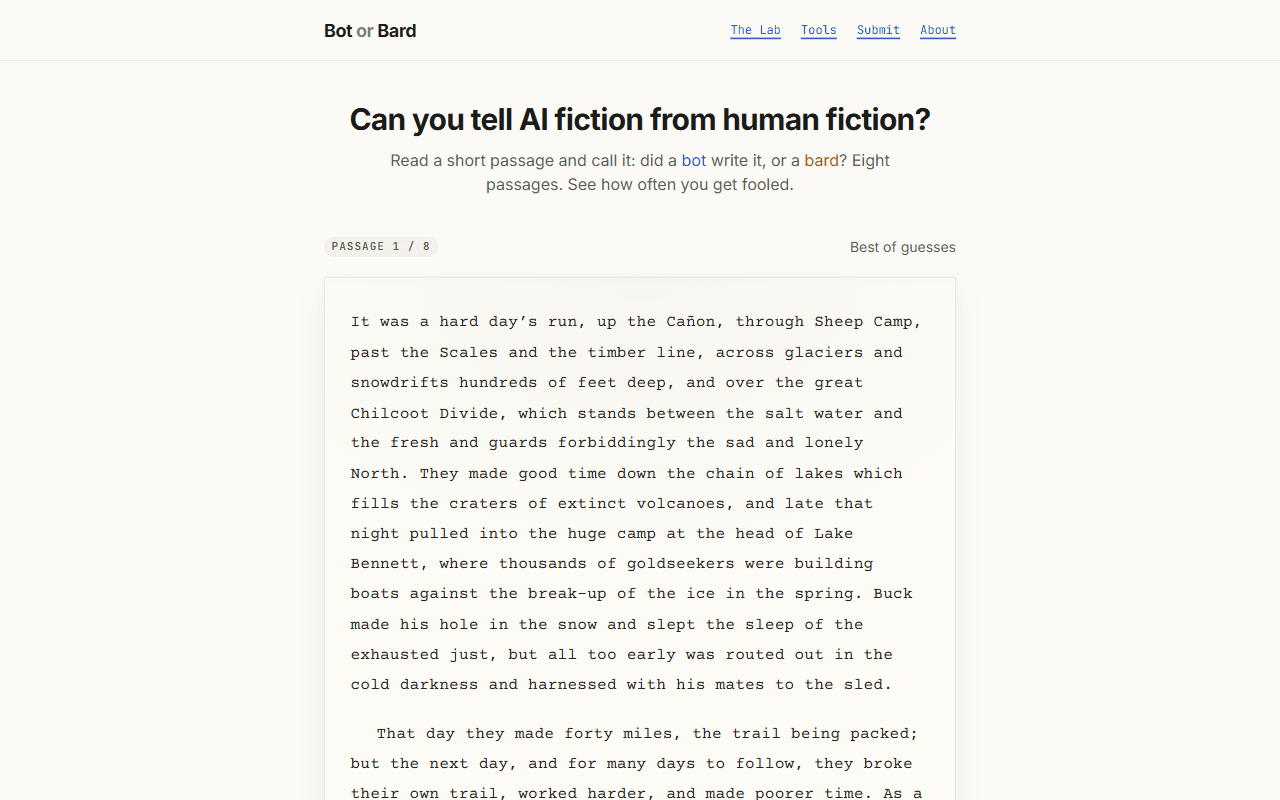
Bot or Bard is the Turing test as a party game: you read a short fiction passage and guess whether a human or an AI wrote it. You find out immediately, your streak is tracked, and the site keeps an aggregate scoreboard of how often people get fooled.
The game is the front end; the interesting part is the dataset it produces. Every guess is a blind judgment about whether a particular piece of machine writing passes for human — which makes the fool-rate a live, crowd-sourced measure of how convincing different generation approaches actually are, as opposed to how convincing people assume they are.
What I was exploring
- Can readers actually tell? The honest answer from the data so far: much less reliably than most players predict before their first round.
- Fool-rate as a metric — passages are generated with different drafting techniques, and each technique accumulates its own fool-rate. It's an A/B test where the players are the judges and don't know it's a test.
- Calibration is the fun — the game shows you your own accuracy over time, which is quietly the same experience as grading your own confidence.
Stack
Next.js and TypeScript. Passages are pre-generated and served from a pool; guesses are logged server-side to build the per-technique fool-rate table.