Overview
An excavation simulator that runs from a URL in WebGL — no Godot, no Unity, no separate client — but aims for better control and realism than a Minecraft-style voxel game. The fun isn't twitch action; it's the grounded process of digging deliberately, conserving material, managing your spoil pile, and shoring up a shaft before it caves in.
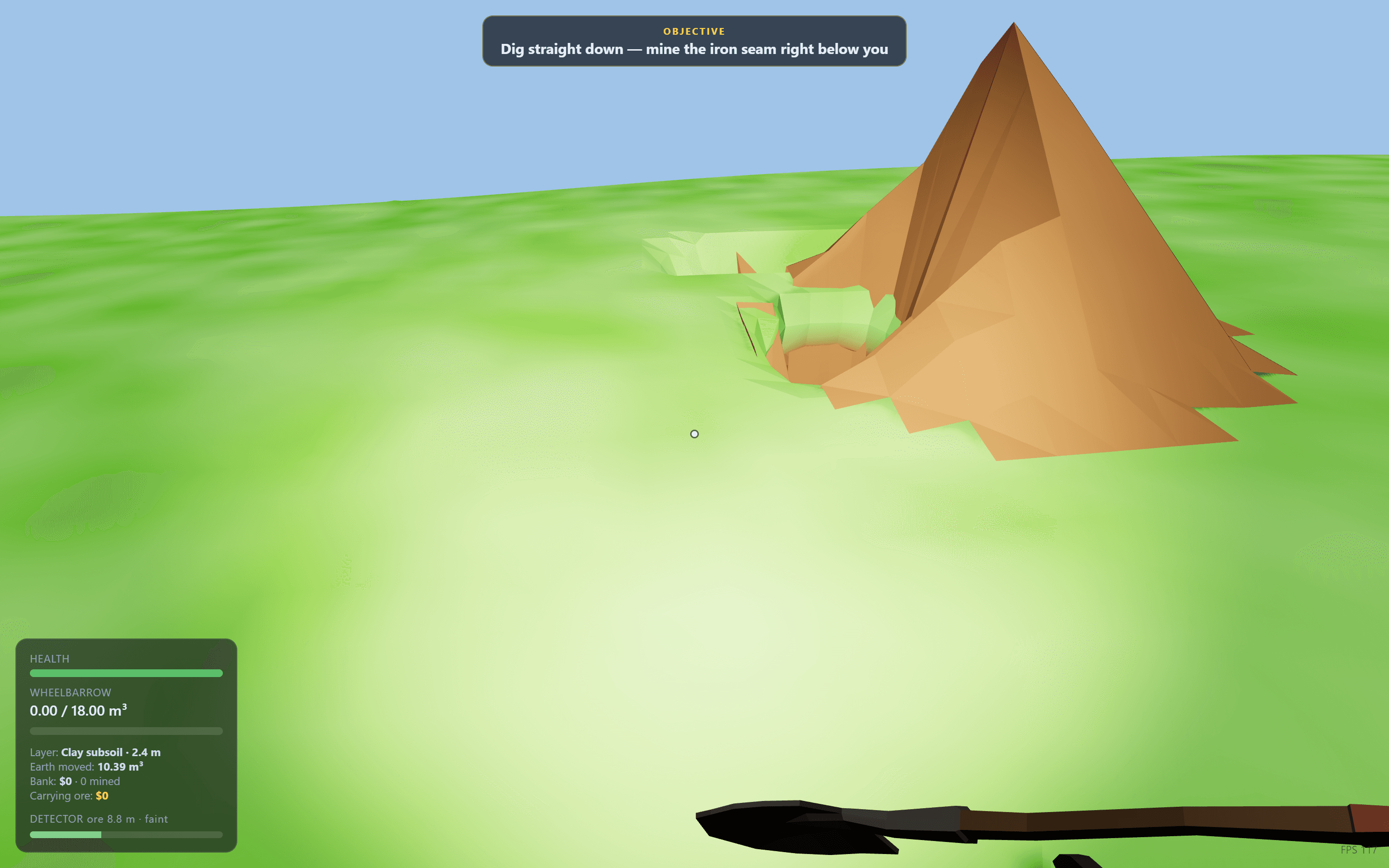
The core idea is to split what "voxel" usually means. It keeps the editable density field (so you can dig anywhere, and treat the ground as a real volume of material) and drops the cube look (the field is rendered as a smooth isosurface mesh via Surface Nets). That combination is what makes believable partial scoops and slumping dirt possible — things cube-voxel games can't do.
Features
- Conservation is the spine — the shovel is a conserved buffer: every cubic meter removed from the ground enters it, and a dump deposits exactly what leaves it. Measured: 4.79 m³ dug equals 4.79 m³ piled.
- Spoil that behaves like dirt — dumped material is a heightfield that relaxes to its angle of repose, forming proper cones and flowing into pits instead of diffusing flat.
- Real strata — layered materials from topsoil down through clay, shale, and granite to bedrock, each with a hardness that gates whether a shovel or a pick can bite. Rock is a hard stop until you build the right tool.
- A dig-and-haul loop — ore salted into the deep rock as veins you follow; you carry your load up to a surface bin to bank it, then spend it on upgrades and a conveyor that automates the climb.
- Collapses, not magic — a falling-sand cellular automaton makes loose soil slump and bury you if you over-dig; placing posts shores a tunnel open.
Stack
TypeScript with Three.js for rendering and Rapier (WASM) for physics. Chunked Surface Nets meshing keeps per-dig cost independent of world size, so the world can be a deep, fully-diggable ~100 m shaft. Custom density-field volume, heightfield spoil, and erosion simulation.